


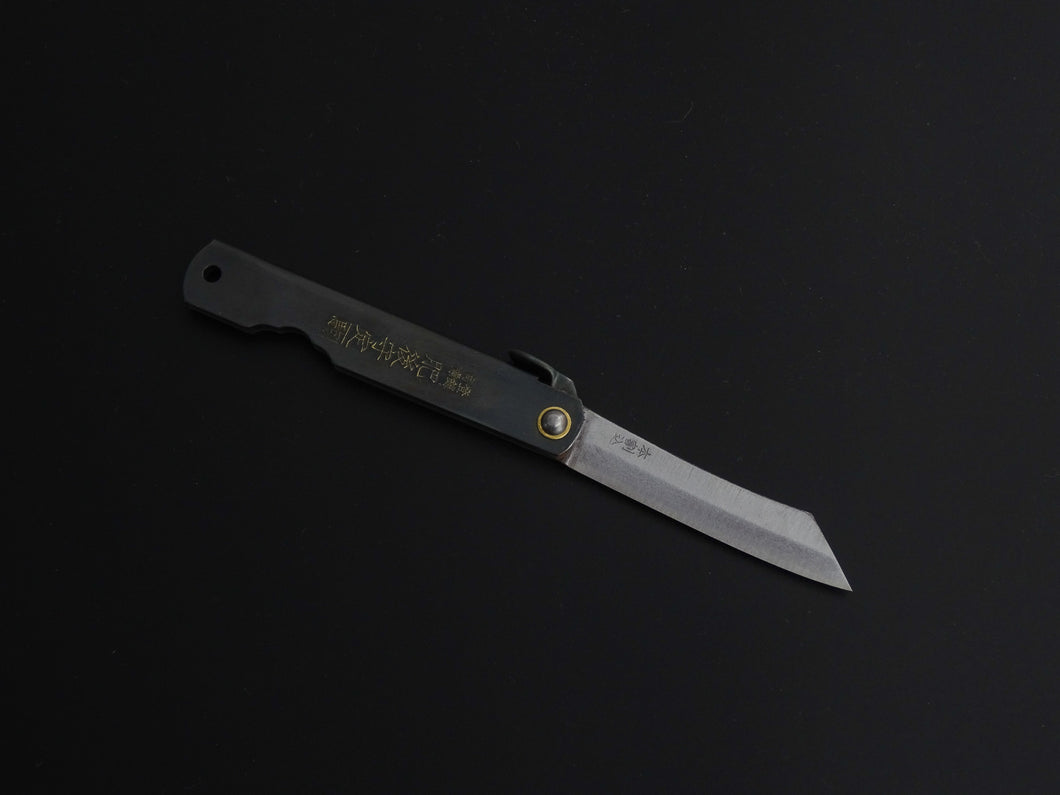


Higonokami SK CARBON STEEL WARIKOMI Craft Knife Black Handle
A Higonokami is a Japanese traditional non-locking pocket knife. History of since 1896 in Miki City, the forged lever used to open the knife. They are great for opening packaging, sharpening pencils, cutting fruit etc.
This is a traditional Japanese, non-locking friction folder with a history dating back to the late 19th century (originating around 1894-1896) in Miki City, Hyogo Prefecture. While its roots are sometimes loosely associated with the transition from the samurai era, its formal history spans over 120 years.
Historical Heritage and Origins
• Post-Samurai Necessity: Following the Meiji Restoration (1868) and the subsequent abolition of the samurai class, sword-making became illegal or severely restricted. Bladesmiths in Miki, a city renowned for metalworking, needed to adapt, leading them to apply their skills to crafting practical, everyday knives.
• Origin of the Design: The knife was created in 1896 in Miki City. It was heavily influenced by a "Higozukuri" (Higo-style) knife brought back from Kyushu by a hardware wholesaler named Tasaburo Shigematsu, who asked blacksmith Teji Murakami to produce it.
• The "Chikiri" Lever: A defining feature of the Higonokami is the chikiri, the extended lever on the blade used for opening, which was added by makers to make it a practical, folding tool.
• Name Origin: "Higonokami" translates to "Lord of Higo," an honorific title given to high-ranking samurai of the Higo region (now Kumamoto prefecture). The name was chosen to boost sales among customers in that region.
• Trademark and Exclusivity: In 1910, the "Higonokami" name was trademarked. Today, only the Nagao Kanekoma Factory, now in its fifth generation of production, is authorized to use the genuine "Higonokami" name on their products.
Legacy and Cultural Significance
• School Tool: For decades, it was a ubiquitous, standard pocket knife used by Japanese schoolchildren to sharpen pencils and for crafts.
• Design Continuity: The design has remained almost unchanged for over a century: a simple, folded-over metal handle and a high-carbon steel blade.
• Survival: The knife survived strict Japanese knife legislation passed in 1961, which caused a sharp decline in popularity, thanks to a niche following of collectors and enthusiasts.
• Hand-Forged Quality: Authentic Higonokami knives are handmade by the Nagao Kanekoma factory, often featuring slight, charming imperfections from the forging process.
Steel : SK Carbon
Blade Length : 75mm
Total Length : 172mm
Weight : 33g
* Please dry thoroughly to avoid rust!!
